Shoulder Pain: An Evidence-Based Guide for Physiotherapy Students and the General Public
Shoulder pain is one of the most common musculoskeletal complaints worldwide. It affects athletes, office workers, manual laborers, and older adults alike. Because the shoulder sacrifices stability for mobility, it is particularly vulnerable to overload, weakness, and movement dysfunction.
This blog integrates foundational principles from Kisner & Colby’s Therapeutic Exercise: Foundations and Techniques (7th ed.) with findings from recent randomized controlled trials (RCTs) (2023–2025). The goal is to present clinically sound information that is academically relevant for physiotherapy students while remaining accessible to the general public.
- Understanding the Shoulder
Key Structures
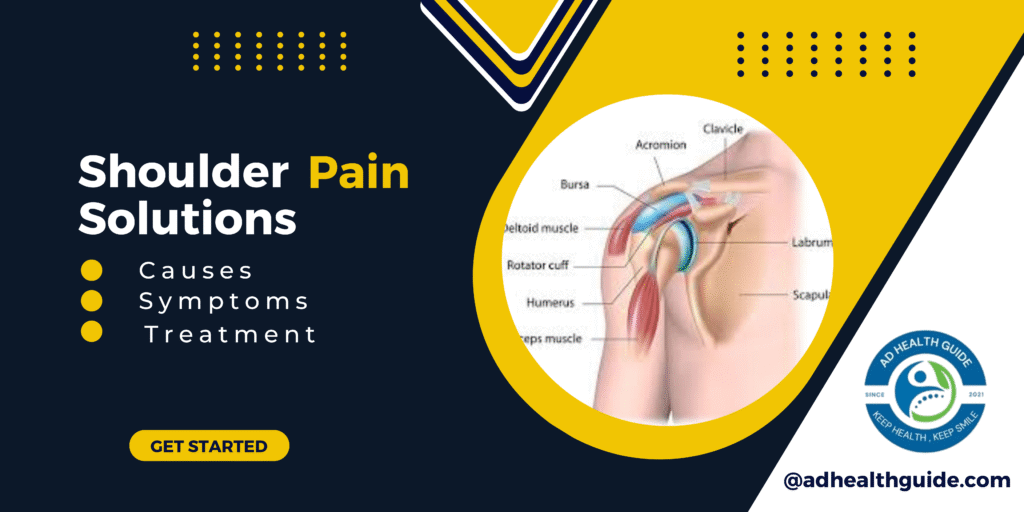
The shoulder complex consists of:
- Glenohumeral (GH) joint (primary movement joint)
- Acromioclavicular (AC) joint
- Sternoclavicular (SC) joint
- Scapulothoracic articulation (functional joint)
The rotator cuff muscles stabilize the humeral head within the glenoid, while the scapular stabilizers (serratus anterior, trapezius, rhomboids) maintain optimal scapular positioning.
For Physiotherapy Students
Kisner & Colby emphasize:
- Scapulohumeral rhythm (2:1 ratio) during elevation
- Balanced force couples (deltoid vs. inferior cuff; upper vs. lower trapezius & serratus anterior)
- Dynamic stabilization and neuromuscular control
Dysfunction frequently arises from altered motor control and load intolerance rather than isolated structural pathology.
For the General Public
Your shoulder works like a golf ball on a tee. Muscles keep the ball centered while you move. If those muscles are weak, tight, or poorly coordinated, pain can develop.
- Common Causes of Shoulder Pain
- Rotator cuff–related shoulder pain (RCRSP)
- Subacromial pain syndrome (SAPS)
- Adhesive capsulitis (frozen shoulder)
- Post-operative shoulder pain
- Instability or labral injury
Modern research encourages clinicians to focus less on “wear and tear” and more on:
- Load tolerance
- Movement quality
- Psychosocial contributors
- Functional limitations
- Evidence-Based Rehabilitation Framework
Rehabilitation should follow tissue healing principles while progressively restoring strength, control, and function.
Phase I: Pain Modulation and Early Activation
Goals
- Reduce pain
- Maintain safe mobility
- Prevent muscle inhibition
Interventions
- Pendulum exercises
- Passive → active-assisted ROM
- Submaximal isometric rotator cuff exercises
- Education on activity modification
Evidence Insight
Recent RCTs demonstrate that Pain Neuroscience Education (PNE) improves psychological outcomes such as fear of movement after rotator cuff repair. This reinforces the biopsychosocial model in musculoskeletal rehabilitation.
For Students
Early isometrics may provide analgesic effects through descending inhibitory pathways and reduce arthrogenic muscle inhibition.
For the Public
Gentle movement is usually better than complete rest. Education about pain reduces fear and improves recovery.
Phase II: Controlled Motion and Strengthening
Goals
- Restore full ROM
- Improve rotator cuff strength
- Correct scapular control
Sample Exercise Progression
|
Exercise |
Dosage |
Purpose |
|
External rotation (band) |
3×12–15 |
Posterior cuff activation |
|
Scapular retraction |
3×12 |
Mid-trapezius strengthening |
|
Serratus wall slides |
3×10 |
Upward rotation facilitation |
|
Quadruped weight shifts |
3×30 sec |
Closed-chain stability |
RCT Evidence
A 2024 RCT found that manual therapy combined with exercise resulted in greater improvements in pain and function compared to exercise alone in subacromial pain syndrome. However, exercise remains the primary long-term driver of recovery.
Clinical Takeaway
Manual therapy may enhance short-term outcomes but should facilitate active rehabilitation rather than replace it.
Phase III: Progressive Loading and Functional Integration
Goals
- Increase tendon load tolerance
- Enhance muscular endurance
- Restore functional movement patterns
Interventions:
- Eccentric rotator cuff strengthening
- Progressive overhead resistance
- Closed-chain stability drills
- Functional and occupational simulation
Kisner & Colby emphasize progressive overload and specificity (SAID principle) for optimal adaptation.
- Return-to-Sport and High-Demand Activity
Return to sport should be criteria-based:
- Pain ≤ 2/10
- Full symmetrical ROM
- Strength ≥ 90% of the opposite side
- Good scapular control
- Completion of sport-specific progression
For Students
Incorporate kinetic chain integration, plyometric loading, and rate-of-force development.
For the Public
Don’t rush back into heavy lifting or throwing. Your shoulder should be strong and pain-free first.
- The Biopsychosocial Approach
Modern shoulder rehabilitation recognizes that:
- Pain does not always equal structural damage
- Fear and anxiety influence recovery
- Education improves outcomes
- Exercise is the cornerstone of treatment
Multimodal approaches (exercise + manual therapy + education) show superior outcomes compared to passive modalities alone.
Key Takeaways
For Physiotherapy Students
- Shoulder pain is often a motor control and load management issue.
- Progressive exercise is the foundation of treatment.
- Manual therapy provides adjunctive benefit.
- Patient education reduces fear-avoidance behaviors.
- Use objective criteria for progression and return-to-sport.
For the General Public
- Stay active within tolerable limits.
- Strengthening exercises are essential for recovery.
- Pain does not always mean damage.
- Recovery is gradual and requires consistency.
References
Kisner, C., & Colby, L. A. (2023) Therapeutic Exercise: Foundations and Techniques (7th Ed.). F.A. Davis.
Recent randomized controlled trials (2023–2025) on:
- Manual therapy plus exercise for subacromial pain
- Pain neuroscience education after rotator cuff repair
- Progressive loading in rotator cuff–related shoulder pain