
You have a solid product. You are putting in the hours. But customers are not coming, and you cannot figure out why. This is one of the most common situations Ad Health sees with new clients. The product is not the problem. The missing piece is almost always the same thing: a clear understanding of marketing fundamentals.
This guide walks you through the core principles that every business needs before spending money on ads, content, or social media. No theory for theory’s sake. Just the practical foundation that makes everything else work.
What Are Marketing Fundamentals?
Marketing fundamentals are the core principles that guide how a business communicates with its audience. They are not tactics or trends. They are the rules underneath every good strategy. Think of them this way: paid ads, social content, and email campaigns are tools. Marketing fundamentals tell you which tools to pick, when to use them, and how to point them at the right people. Without this foundation, businesses end up spending money on campaigns that feel active but produce nothing. The fundamentals fix that.
At their core, marketing fundamentals cover five areas:
- Knowing who your customer actually is
- Making sure your product solves a real problem
- Pricing your offer in a way that makes sense
- Choosing the channels where your buyers already spend time
- Tracking results so you can improve over time
Get these five things right and everything else becomes easier to execute.
Understanding Your Target Audience
The most important question in marketing is also the most skipped one: who are you actually selling to? Not a general category. Not a demographic bucket. A real person with a specific problem who is actively looking for a solution.
Everything in your marketing, from the words you use to the platforms you choose, flows from how well you understand this person. Get it wrong and your message lands flat with everyone. Get it right and even a simple post can drive real results.
Here is how to build a useful picture of your target customer:
What problem do they have? Not what your product does. What is the pain they are sitting with right now?
What are they searching for? The exact phrases people type into Google tell you exactly how they think about their problem. Tools like Google Search Console, Answer the Public, or simply reading comment sections in relevant forums give you this language for free.
Where do they look for answers? Some buyers research on YouTube. Others read LinkedIn posts. Others ask friends. Knowing where they go means you show up in the right place instead of guessing.
One good customer profile, written down clearly, is worth more than any marketing course. Start there.
How to Build a Buyer Persona
A buyer persona is a one-page profile of your ideal customer. It is not a fictional character exercise. It is a practical tool that keeps your marketing focused when you are making decisions under pressure.
A useful persona includes:
Name and role: Give them a name and describe what they do professionally and personally. This makes it easier to write for them instead of writing into a void.
Primary goal: What are they trying to accomplish? Not in life in general, but in relation to the problem your product solves.
Biggest obstacle: What keeps getting in their way? This is where your messaging should live. The best marketing does not sell a product. It names a problem the customer already feels.
Preferred channels: Where do they go when they want information? This decides where you show up.
You do not need a marketing agency or a complex survey to build this. Talk to five existing customers for twenty minutes each and you will have everything you need.
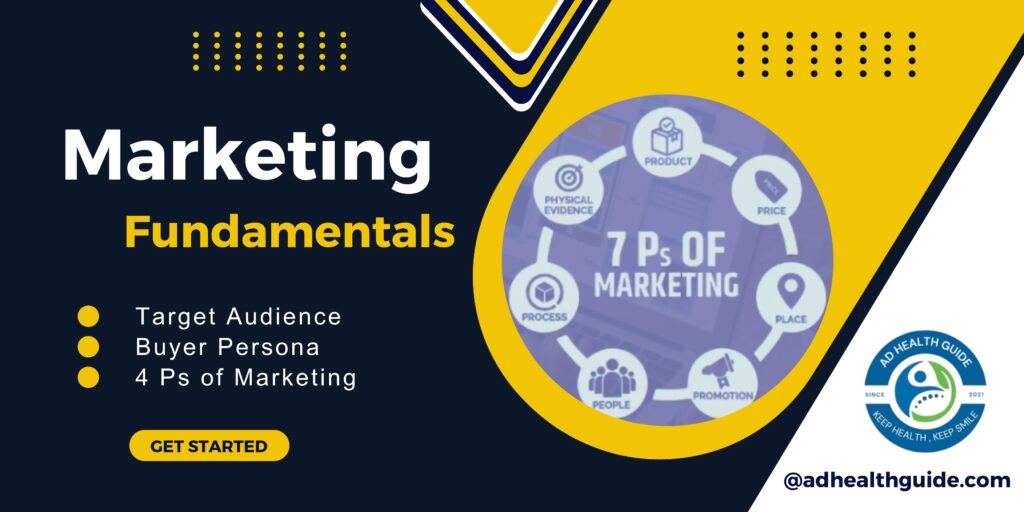
The 4 Ps of Marketing
The 4 Ps are one of the oldest frameworks in marketing, and they are still taught because they still work. Before you spend anything on promotion, run your offer through all four.
Product
Your product needs to solve a specific, real problem. Not a problem you think people have. A problem they are already spending time and money trying to fix. The test: can you explain in one sentence why someone would choose you over the alternative? If that answer takes longer than twenty seconds, the positioning needs more work.
Price
Pricing sends a signal before a customer reads a single word of your copy. Too low and people question the quality. Too high without visible justification and they go elsewhere.
Research what your competitors charge. Understand what your customer currently pays to solve the same problem another way. Then price with intention, not just intuition.
Place
Where does your customer actually go to buy things? Not where you wish they would go. Where they already are. An e-commerce brand selling to Gen Z has no business pouring budget into Facebook. A B2B service selling to procurement managers has no business ignoring LinkedIn. Place is about meeting buyers where they already are, not asking them to change their habits to buy from you.
Promotion
Promotion is the part most businesses start with. It is the last of the four Ps for a reason. Ads, content, and social posts amplify what you already have. If the product is unclear, the price is off, or the distribution does not match the buyer, promotion makes all of that worse faster. Nail the first three and promotion becomes significantly easier to do well.
Key Marketing Channels and How to Choose
Not every channel fits every business. The goal is not to be everywhere. The goal is to be in the right places consistently.
Search Engine Optimization (SEO)
SEO helps your website appear when people search for what you sell. It takes time to build, but the results compound. A well-optimized page can bring in qualified traffic for years without ongoing ad spend. Start with the questions your customers are already typing into Google and write content that answers them clearly.
Social Media Marketing
Social media works when you choose platforms based on where your audience actually is, not where you personally spend time. LinkedIn is the right call for most B2B businesses. Instagram and TikTok work well for visual consumer products. Twitter and Reddit are underrated for building authority in niche industries. Pick one or two and do them consistently rather than spreading thin across all of them.
Email Marketing
Email is the most underused channel for most small businesses. When someone gives you their email address, they are asking to hear from you. That is a level of permission you do not get on social media. Use email to share genuinely useful information, not just promotions. People who learn something from your emails are far more likely to buy when you eventually make an offer.
Paid Advertising
Paid ads can generate results quickly, but they stop the moment you stop paying. This makes them useful for testing and for scaling what already works, but a poor foundation for sustainable growth. Start with a small daily budget on one platform. Measure cost per click and cost per lead carefully. Scale only what is producing results at a cost that makes sense for your business.
The Marketing Funnel
The marketing funnel describes the path someone takes from first hearing about you to actually buying from you. Understanding it means you stop sending the wrong message at the wrong time.
Awareness is where someone first discovers you exist. They are not ready to buy. They are just becoming aware of the problem or the category. Your job here is to make a good first impression and give them something worth remembering.
Consideration is where they start comparing options. They know the problem. They know solutions exist. Now they are deciding which one to trust. Case studies, honest reviews, and educational content do the heavy lifting at this stage.
Conversion is where they are ready to buy. At this point, friction is your enemy. A confusing checkout, a slow page, or an unclear offer will lose people who were already ready to say yes. Make the final step as simple as possible.
Most businesses only create content for one stage of the funnel and then wonder why the other two are not converting. A simple content plan that covers all three stages fixes most pipeline problems.
B2B vs B2C Marketing
Both B2B and B2C marketing use the same fundamentals. But how those fundamentals play out in practice is quite different.
B2B marketing (business-to-business) involves longer decision cycles. More people are usually involved in approving a purchase. Buyers want data, case studies, and proof of ROI before committing. LinkedIn, long-form content, and direct outreach tend to work well here.
B2C marketing (business to consumer) moves faster. Individual buyers often make emotional decisions quickly. Social proof, short-form video, and peer reviews can be decisive. The window to capture attention is narrow, so clarity matters more than depth.
Knowing which model you operate in changes how you allocate time, budget, and content across your channels.
How to Build a Simple Marketing Strategy
A marketing strategy does not need to be a long document. It needs to be clear enough that you can make decisions from it without reading it twice.
Here is a format that works:
Define one goal. Revenue growth, lead generation, brand awareness — pick one primary objective for the next 90 days. Trying to achieve everything at once produces nothing.
Write down your buyer persona. One page. Who they are, what they need, what they worry about, where they spend time.
Choose two channels. Not five. Not seven. Two channels, done consistently and well, will outperform five channels done poorly every time.
Plan your content for four weeks. Decide in advance what you will publish, where, and when. Consistency matters more than volume when you are starting out.
Review results every week. Spend thirty minutes looking at what performed and what did not. Marketing that is not measured is just spending money on hope.
Measuring What Actually Matters
Vanity metrics, likes, follower counts, and impressions feel like progress but rarely connect to revenue. These are the numbers worth watching instead:
Website traffic from organic search: Are people finding you through Google? This grows slowly but signals that your content is earning trust.
Conversion rate: Of everyone who visits a key page, how many take the action you want? Even small improvements here compound significantly over time.
Cost per lead: If you are running paid campaigns, this number tells you whether the channel is sustainable. Track it from day one.
Email open and click rates: If people are not opening your emails, your subject lines or sending frequency need to change. If they open but do not click, the content or the offer is the problem.
Check these weekly. When a number improves, understand why before assuming it will continue. When a number drops, investigate before making reactive changes.
Staying Current Without Chasing Every Trend
Marketing principles do not change often. What changes is how they get applied. The businesses that stay ahead are not the ones chasing every new platform or format. They are the ones with a solid foundation who can adapt their approach when the environment shifts.
A few things worth paying attention to in 2026:
Search behavior is changing. AI-powered answers in Google are shifting how people find information. Writing that directly answers specific questions in plain language is performing better than content written primarily to rank for keywords.
Short-form video is still the highest reach format for most consumer audiences. If your buyer is under 40, video is worth testing even if it feels uncomfortable.
First-party data is increasingly valuable. Email lists and direct customer relationships matter more as third-party tracking becomes less reliable. Building an email list now is a more defensible long-term asset than a social following.
None of this replaces the fundamentals. It just changes how you apply them.
Conclusion
Marketing fundamentals are not complicated. They are just the basics, done right and done consistently. Know your customer. Make sure your product solves a real problem. Price it with intention. Show up where your buyers already are. Track the numbers that actually tell you something.
Most businesses that struggle with marketing are not making big dramatic mistakes. They are skipping small steps and then wondering why the results are not coming. If you want help getting these foundations right for your specific business, the team at Ad Health works with companies at exactly this stage. We focus on the basics that move results, not the tactics that just look impressive in a report.